
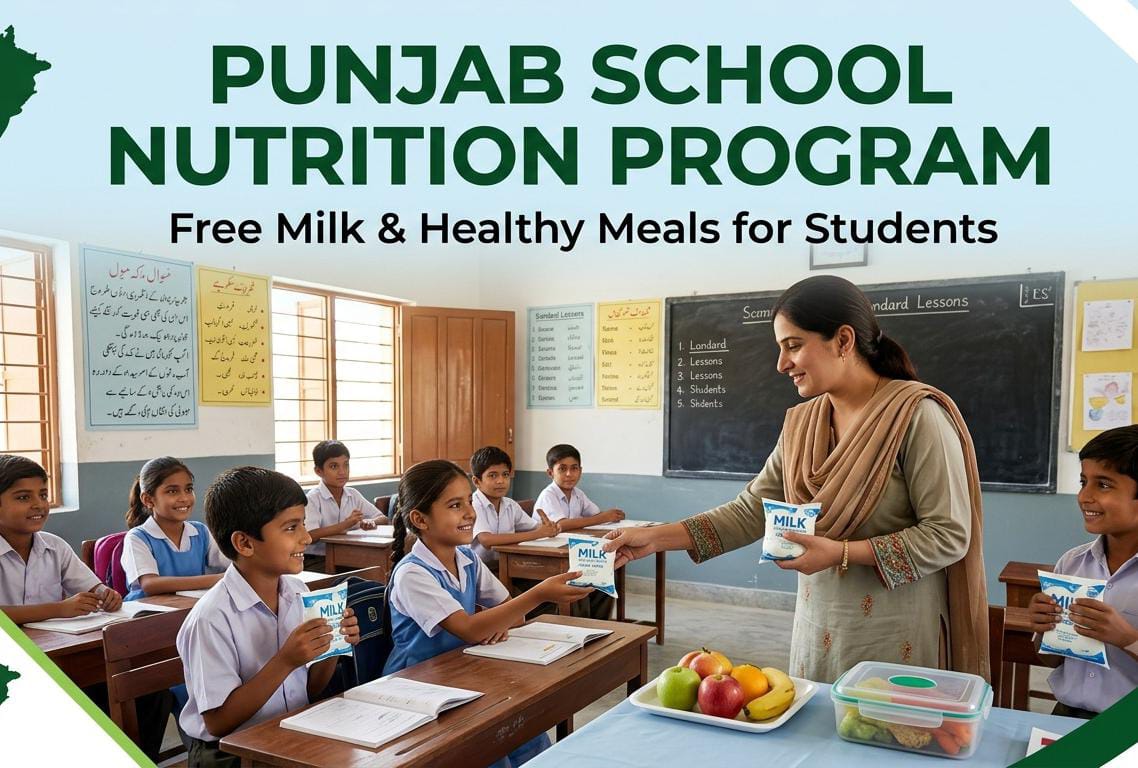
CM Punjab School Nutrition Program 2026: Complete Overview & Registration Details
Childhood malnutrition remains one of the most critical public health challenges affecting primary education across rural Pakistan. Deficiencies in vital micronutrients lead to stunted growth, weakened immunity, and poor classroom concentration—factors that directly contribute to high dropout rates in primary schools. To tackle this issue head-on, Chief Minister Maryam Nawaz Sharif launched the expanded CM Punjab School Nutrition Program 2026.
Executed under the School Education Department (SED) and managed by the Program Monitoring & Implementation Unit – Punjab Education Sector Reform Programme (PMIU-PESRP), this social initiative delivers free, highly nutritious milk packs and fortified biscuits to primary school students across high-poverty districts in Punjab.
Originally piloted in South Punjab, the program now spans 14 targeted districts, reaching over 1.19 million primary school students. Beyond immediate dietary support, the initiative integrates a zero-waste recycling model that converts empty milk cartons into funds for local school improvements.
Also Read:
CM Punjab Women Business Incubation Program 2026: Apply Online & Eligibility Guide
Key Program Highlights & Overview
The program represents a significant provincial investment designed to raise primary health and learning standards in public schools:
| Program Component | Official Program Details |
| Sponsoring Agency | School Education Department (SED), Government of the Punjab |
| Executing Body | PMIU-PESRP (Punjab Education Sector Reform Programme) |
| Total Program Budget | Exceeds PKR 6.99 Billion |
| Student Coverage | 1,190,000+ primary school students (ECE to Grade 5) |
| School Coverage | 8,723 standalone primary schools |
| Nutritional Provision | Free 175ml milk pack (3 days/week) + Fortified Biscuits (1 day/week) |
Strategic Objectives of the Program
The School Nutrition Program focuses on four primary goals:
-
Combating Malnutrition & Stunted Growth: South Punjab and neighboring rural belts report high rates of iron and calcium deficiencies. Daily milk consumption supplies the essential vitamins, calcium, and protein necessary for physical and cognitive growth.
-
Increasing School Enrollment & Attendance: Guaranteed daily nutrition serves as a practical financial incentive for low-income families, encouraging parents to keep children enrolled and reducing chronic absenteeism.
-
Improving Cognitive Performance & Focus: Undernourished students often struggle with short-term memory and low energy levels in class. Timely nutrient intake improves daily concentration and academic retention.
-
Building Healthy Habits: Early nutrition intervention instills long-term dietary awareness among children, parents, and local communities.
Covered Districts in Punjab
The current phase prioritizes districts with high poverty rates and documented malnutrition indicators:
-
Target Districts: Dera Ghazi Khan, Muzaffargarh, Rajanpur, Kot Addu, Taunsa, Layyah, Bhakkar, Mianwali, Lodhran, Rahim Yar Khan, Vehari, Chiniot, Bahawalnagar, and Attock.
Program Framework & Daily Distribution Model
Environmental Impact: This recycling framework processes over 13 million milk cartons per month, preventing plastic packaging waste while creating a sustainable revenue stream for primary school maintenance.
Student Eligibility Criteria
Parents do not need to fill out separate application forms or pay any fees. Eligibility is automatic based on school enrollment:
-
Grade Level: Must be an actively enrolled student in Early Childhood Education (ECE) up to Grade 5.
-
School Status: Must attend an official public standalone primary school operating within the 14 selected districts.
-
Attendance: Students must maintain regular physical attendance to receive daily nutritional items during morning school hours.
Frequently Asked Questions (FAQs)
1. What is the CM Punjab School Nutrition Program 2026?
It is a Punjab government initiative that provides free 175ml milk packs and fortified biscuits to primary school children to combat malnutrition, boost attendance, and support early health development.
2. How many students benefit from this program?
The expanded phase targets more than 1.19 million primary school students across 8,723 government schools.
3. Which age groups and grades are covered?
Children enrolled from ECE (Early Childhood Education) through Grade 5 in participating public primary schools are eligible.
4. Do parents need to register online or pay a fee?
No. Enrollment in a participating government primary school automatically qualifies the student. The program is completely free.
5. What food items do students receive?
Students receive a 175ml milk pack 3 days a week and a pack of fortified biscuits 1 day a week.
6. Which districts are included in the current phase?
The scheme covers 14 districts: D.G. Khan, Rajanpur, Muzaffargarh, Kot Addu, Taunsa, Layyah, Bhakkar, Mianwali, Lodhran, Rahim Yar Khan, Vehari, Chiniot, Bahawalnagar, and Attock.
7. How does the milk pack recycling system work?
Empty milk cartons are collected after consumption, sent to certified recycling plants, and the proceeds are deposited into individual school improvement funds.
8. Which department manages the program?
The program is sponsored by the School Education Department (SED) and managed by the Program Monitoring & Implementation Unit (PMIU-PESRP).
9. How does the program improve academic performance?
Proper daily nutrition reduces health-related absenteeism, boosts energy levels, and enhances memory retention and classroom focus.
10. Will the program expand to other districts in Punjab?
Yes. Following initial pilots in South Punjab, the government plans to expand coverage across additional districts in phased rollouts.
Official Website Links
-
PMIU – Punjab Education Sector Reform Programme: pesrp.edu.pk
-
School Education Department Punjab: schools.punjab.gov.pk
-
Government of Punjab Official Portal: punjab.gov.pk
Conclusion & Legal Disclaimer
Conclusion
The CM Punjab School Nutrition Program 2026 represents a crucial step forward in combining public health with basic education. By providing daily nutritional support alongside an innovative recycling model, the Government of Punjab addresses child stunting while improving classroom attendance and academic performance across underserved communities.
Legal Disclaimer
This article is provided for general public awareness and educational purposes based on official state releases. Distribution schedules, covered districts, and program guidelines remain subject to change by the School Education Department (SED) and the Government of the Punjab. Parents should consult local school administrators for district-specific updates.
CM Punjab School Nutrition Program 2026, CM Punjab School Meal Scheme, Free Milk Distribution Punjab Schools, Maryam Nawaz School Nutrition Program, PESRP School Meal Program, Primary School Nutrition Scheme Punjab, SED Punjab Free Milk Scheme, South Punjab School Meal Project, PMIU PESRP Nutrition Program, Green Punjab School Recycling Initiative.
Published By: Pak Schemes Team
Date : 25 July 2026
Topic :CM Punjab School Nutrition Program 2026: Complete Guide & Student Benefits