
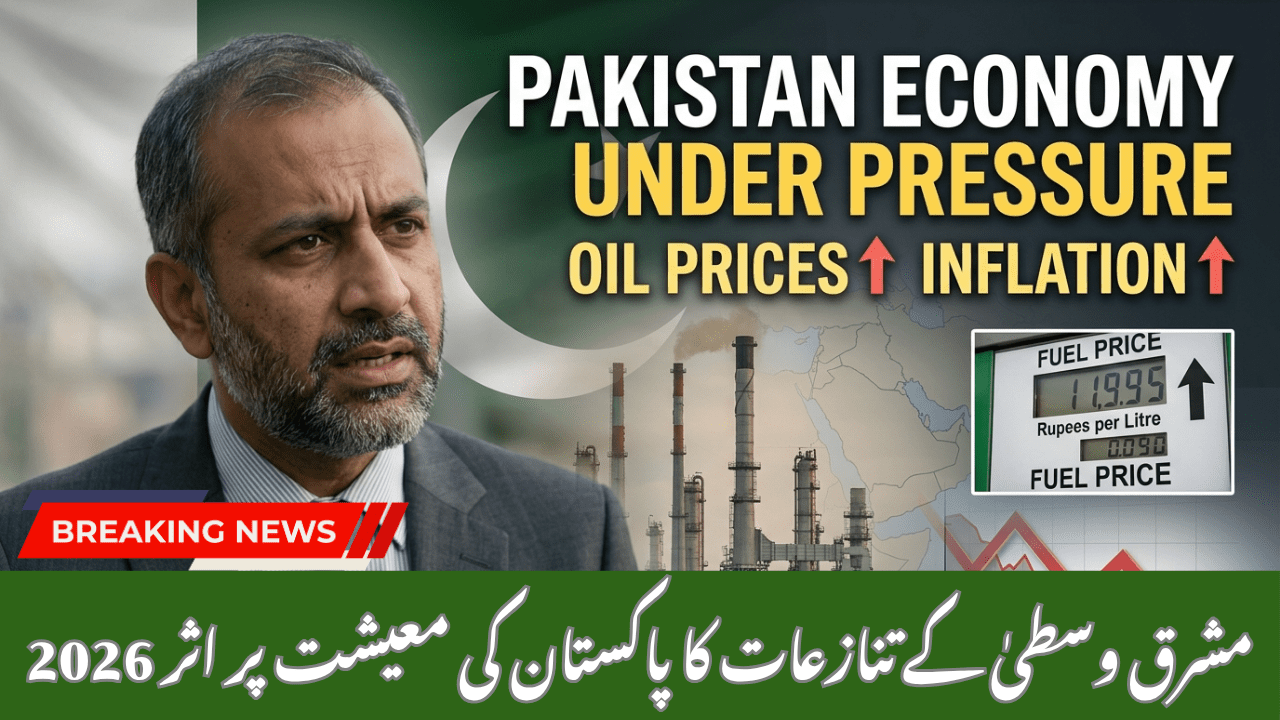
Middle East Conflict Impact on Pakistan Economy 2026
The ongoing Middle East Conflict Impact on Pakistan Economy has started to create serious economic challenges for Pakistan. Government officials have warned that the situation may lead to rising inflation, higher oil prices, and slower economic growth in the coming months. As Pakistan heavily depends on imported fuel and global trade stability, any disturbance in the Middle East directly affects its economy.
Rising Inflation in Pakistan
One of the most immediate impacts of the Middle East Conflict Impact on Pakistan Economy is increasing inflation. Pakistan already faces high inflation, and further pressure from global uncertainty is making things worse. When global supply chains are disrupted, the cost of importing goods rises. This includes essential items such as fuel, food, and raw materials.
Higher transportation costs also contribute to inflation. As oil prices increase, the cost of moving goods from one place to another rises, which eventually affects the prices consumers pay in markets. This creates a ripple effect across the entire economy.
Also Read:
Petrol Price Increase in Pakistan 2026 – New Rates Reach Rs. 393.35 Per Litre
Oil Prices and Energy Crisis
Pakistan imports a large portion of its oil from international markets, many of which are connected to the Middle East. When tensions rise in the region, oil supply becomes uncertain, and prices increase globally.
Higher oil prices lead to:
- Increased electricity generation costs
- Higher petrol and diesel prices
- Increased burden on government subsidies
This not only affects individuals but also industries. Manufacturing costs rise, businesses struggle to maintain profits, and production may slow down. As a result, unemployment risks can also increase.
Also Read: BISP Payment Increase 2026 – New Amount Rs. 10500 to 13500 | Latest Update
IS Middle East Conflict Impact on Pakistan Economy Slower Economic Growth
Economic growth depends on stability, investment, and production. Unfortunately, geopolitical conflicts create uncertainty, which discourages both local and foreign investment.
Due to the Middle East Conflict Impact on Pakistan Economy:
- Investors become cautious
- Imports become expensive
- Export competitiveness decreases
All these factors combine to slow down Pakistan’s GDP growth. The government has already indicated that growth projections for this year and the next may be lower than expected.
Pressure on Foreign Reserves
Another major concern is Pakistan’s foreign exchange reserves. When oil prices rise, Pakistan has to spend more dollars to import fuel. This increases pressure on already limited reserves.
If reserves decrease significantly:
- Currency depreciation may occur
- Imports become even more expensive
- Debt repayment becomes harder
Middle East Conflict Impact on Pakistan Economy creates a challenging economic cycle that requires careful management by policymakers.
Government Response and Strategy
The government is actively monitoring the situation and may take several steps to reduce the impact:
- Controlling unnecessary imports
- Promoting local production
- Seeking alternative energy sources
- Negotiating better trade agreements
Long-term strategies may also include investing in renewable energy to reduce dependence on imported oil.
Global Impact and Pakistan’s Position
The Middle East is a key region for global energy supply. Any instability there affects not only Pakistan but the entire world. However, developing countries like Pakistan feel the impact more strongly due to limited economic resilience.
Pakistan may also try to play a diplomatic role in easing tensions, which could improve its global standing while indirectly benefiting its economy.
FAQs
1. How does the Middle East conflict affect Pakistan?
It impacts oil prices, trade routes, and overall economic stability, leading to inflation and slower growth.
2. Why are oil prices increasing?
Due to supply uncertainty and geopolitical tensions in oil-producing regions.
3. Will petrol prices increase in Pakistan?
Yes, higher global oil prices usually lead to higher local fuel prices.
4. How does inflation affect common people?
It reduces purchasing power and increases the cost of living.
5. Can Pakistan control inflation?
Partially, through policy measures, but global factors also play a major role.
6. What sectors are most affected?
Transport, manufacturing, energy, and agriculture.
7. Will economic growth stop completely?
No, but it may slow down compared to expectations.
8. How does it affect the Pakistani rupee?
It can weaken due to increased demand for foreign currency.
9. What can the government do?
Reduce imports, increase exports, and invest in alternative energy.
10. Is Middle East Conflict Impact on Pakistan Economy impact temporary or long-term?
It depends on how long the conflict continues.
Rising Oil Prices
Pakistan imports the majority of its crude oil and petroleum products from Gulf countries. Any disruption in the Strait of Hormuz or surrounding shipping lanes immediately affects fuel prices.
As oil prices rise:
- Petrol and diesel become more expensive.
- Electricity generation costs increase.
- Transportation costs rise nationwide.
- Industrial production becomes more expensive.
Recent escalations in the Middle East have pushed global oil prices higher because of concerns over supply disruptions.
Conclusion
The Middle East Conflict Impact on Pakistan Economy is creating serious economic challenges for Pakistan. Rising inflation, increasing oil prices, and slower economic growth are key concerns. While the government is taking steps to manage the situation, the overall impact depends largely on global developments. Strengthening local production and reducing reliance on imports will be crucial for long-term stability.
Disclaimer
Middle East Conflict Impact on Pakistan Economy article is for informational purposes only. Economic conditions may change based on global developments, government policies, and market trends. Readers are advised to follow official sources for the latest updates.
Official Website
For official updates, visit: https://www.finance.gov.pk
Published By: Editor
Date : 26 July 2026
Topic :Middle East Conflict Impact on Pakistan Economy 2026: Inflation, Oil Prices & Growth Slowdown